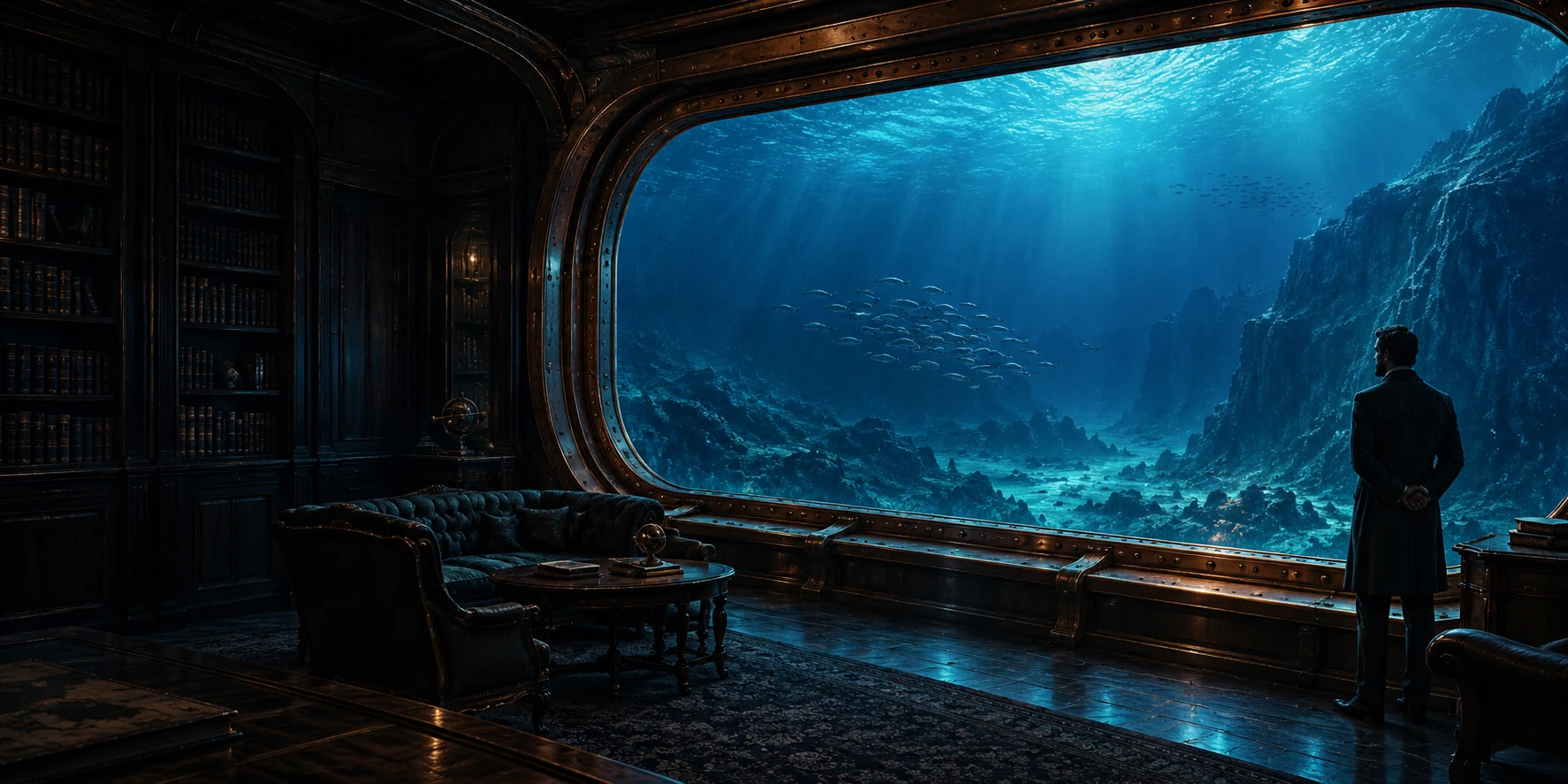
An imagined nineteenth-century Nautilus salon, where a lone observer looks through a copper-framed window into a luminous blue ocean.

ACADEMY / THE IMAGINATION OF LEARNING

Entering
the Nautilus.

A voyage into deeper understanding.

What becomes visible when we leave the familiar surface and give a question room to take us further?

Enter the voyage
ATTENTION · DISCOVERY · UNDERSTANDINGAn imagined scene inspired by Jules Verne’s Nautilus

THE VOYAGE OF LEARNING

Carry a question.
Discover a wider world.

The Nautilus gives Academy an image for study: a place from which to look closely, travel together, and let experience deepen what we understand.

Explore the learning map

Supraluminal // Where Coherence Takes Flight

01 / BENEATH THE SURFACE

The world exceeds
our first account of it.

A literary reflection by Stardyne on Jules Verne’s Twenty Thousand Leagues Under the Sea.

Reading notes and sources

Imagine standing inside a vessel while the ocean opens beyond its windows. A world you have crossed many times has become a world you can enter.

In Verne’s novel, Professor Aronnax sets out to investigate what is believed to be a sea creature. The encounter brings him aboard Captain Nemo’s submarine, the Nautilus. An explanation that seemed plausible from a distance gives way to something his first account had not allowed for.

That change of position gives learning a powerful setting. We arrive with descriptions inherited from teachers, books, family, and experience. They help us find our bearings. Then something happens that asks more of the description: a responsibility grows, a familiar answer leaves a question untouched, or another person sees what we have missed.

Entering the Nautilus begins with the willingness to stay with that moment. We can take our existing knowledge seriously while allowing the encounter to enlarge it. A useful question holds the opening: what is here that I have not yet learned to see?

For Academy, this is an invitation into sustained study. A question becomes a route through sources, conversation, practice, and reflection. The learner has a reason to continue because the world is beginning to disclose more.

02 / A ROOM FOR THOUGHT

Take a place
for thinking with you.

A library travels beneath the sea.

Among the wonders Aronnax encounters aboard the Nautilus is a library. The ship carries books into the very environment that invites fresh observation. Reading and encounter can accompany one another.

This is a generous image for an education. We need places to return to while a question remains unsettled: a source we can read again, a notebook that preserves the earlier attempt, a teacher who can help us name a difficulty, a conversation with enough time to become precise.

A room for thought can be very ordinary. Someone learning to lead might begin with one meeting, then make time afterward to examine what happened. Who spoke? Which concern remained unheard? What did the leader assume? The next meeting becomes an opportunity to try something learned from the first.

Structure makes this kind of attention possible. A clear task, a shared vocabulary, and an agreed time to review the experience give the learner somewhere to stand. They make it easier to say, “I do not understand this yet,” and then continue working.

The Academy’s proposed seminar, scenario, and studio settings give that relationship different forms. A seminar keeps an idea close to its source. A scenario lets a decision be examined. A studio brings an idea into work that others can encounter. Together, they offer ways to carry study into experience and bring experience back into study.

03 / OPEN THE WINDOWS

Give attention
time to become sight.

The familiar word may have more to show us.

In the darkened salon, panels open and the illuminated sea comes into view. The room becomes a place from which to witness a living world.

There is a learning moment like this when a familiar word becomes connected to something we can finally recognize. “Responsibility” may begin as a definition. Later it acquires the weight of a promise someone is relying on. “Attention” becomes more specific when we notice how quickly we prepare a reply while another person is still speaking.

In Carroll’s original Entering the Nautilus reflection, the unknown is a place in which to become attentive. The talk returns to quiet, listening, and the possibility of receiving an understanding that our present concepts cannot yet supply. This Academy reading carries that invitation into the work of inquiry.

We can begin by letting an observation remain open a little longer. Read the whole passage around the sentence that caught your attention. Ask someone what they meant. Describe what happened before deciding why it happened. Let the first explanation meet another possibility.

Time spent here can change the quality of the next question. A learner who begins with “Why did this fail?” might discover that success had never been defined together. A different conversation becomes possible once the missing agreement can be seen.

The window opens when we become available to what the encounter can teach. Attention gives the subject enough room to answer in its own detail.

04 / LEARN IN COMPANY

A wider view
needs other voices.

Discovery becomes richer when people can bring different questions.

Aronnax, Conseil, and Ned Land share a voyage while responding to it differently. Scientific fascination, habits of classification, and the desire for freedom do not produce the same account of life aboard the vessel.

A group entering unfamiliar work needs that variety of attention. One person can explain the underlying idea. Another notices the practical difficulty. Someone else asks about the people who will live with the result. Each may be looking through a different window onto the same undertaking.

Learning in company asks us to make those observations available to one another. Before defending a conclusion, we can ask what led someone else to theirs. What did they notice? What experience do they bring? Which consequence matters most to them?

The novel also gives this image a limit. The Nautilus holds its visitors captive. Its extraordinary possibilities do not resolve the question of their freedom. An Academy inspired by its capacity for discovery needs a different relationship between guide and learner: questions can be voiced, disagreement can be examined, and participation remains a choice.

Shared study grows through the quality of that relationship. A teacher can offer direction while welcoming a correction. A learner can receive guidance while developing judgment. The company makes a further journey possible when everyone has room to contribute to what is understood.

05 / RETURN WITH MORE TO SEE

A familiar question.
A changed reader.

Later experience can illuminate an earlier page.

Some of the most useful learning happens on a return. You read a passage again after carrying a difficult responsibility. A sentence you once understood in outline now names something you have lived. The text is familiar; your capacity to meet it has grown.

Knowledge Design for Academy proposes a learning environment in which ideas are revisited and connected. A source can support a readable essay, a case, a reflection, and a practice. Each offers another way to approach the question while preserving the relationship to the original record.

That gives the learning map its purpose. Someone can enter through identity, follow a question into responsibility, and later return to identity with a more concrete understanding of what a commitment asks. A reader interested in interpretation can move from a principle to a worked example, then bring the example back to the principle.

Keeping the earlier record matters. Write down what you thought before the experience and what you think afterward. The difference may reveal an assumption, a useful correction, or a part of the question that deserves further study. An earlier understanding can be honored for what it made possible and revised where it was incomplete.

Return gives growth a history. We can see where a word gained meaning, where a judgment became more careful, and where a question became more generous. The voyage continues through a world that now has more to show us.

06 / BRING SOMETHING BACK

Let discovery
enter ordinary life.

Understanding finds a next expression in practice.

The original Nautilus talk recalls the rhythm of a flight: brief together, enter the experience, then debrief. That movement gives discovery a place in shared life. Preparation helps us attend; reflection helps us carry something forward.

Try it with one question. Begin by naming what you want to understand and reading something that gives it context. Choose a small, manageable practice. Afterward, describe what happened, what surprised you, and what remains unresolved. Invite a response from someone able to help you examine it.

A person studying attention might ask a colleague to explain a concern, then repeat what they heard and check whether they understood it. Someone studying responsibility might make one clear agreement and return to discuss how it was carried. These encounters give the idea detail.

The result may be a changed habit, a better question, or the recognition that more study is needed. Each gives the next step a firmer basis. Over time, the record of these returns can show how understanding is becoming available in the way a person works, listens, and contributes.

Entering the Nautilus is an image for this willingness to learn: take the question seriously, prepare a place for attention, and travel far enough to be surprised. Then bring what you have seen into a conversation, a practice, and a life that can continue to grow.

READING IN CONTEXT

The story and
the source material.

Jules Verne, Twenty Thousand Leagues Under the Sea (1869–1870). Part One, chapters 1, 7, 10, 11, and 13 supply the encounter, the library, the observation windows, and the contrasting responses to captivity.

Carroll Moffitt, Entering the Nautilus, PH10-3, an original spoken reflection. Its opening image is the chambered sea creature; its subsequent themes include growth, attention, unknowing, shared exploration, and the rhythm of briefing and debriefing.

Knowledge Design for Academy, a working design conversation, supplies the educational connection: preserving source records, developing related forms of study, and returning to ideas as understanding grows.

This is a new editorial essay, bringing those questions into conversation with Verne’s vessel. The educational applications and imagined illustration are Stardyne’s interpretation. The illustration was created for this reading; it is not a plate from a historical edition.